
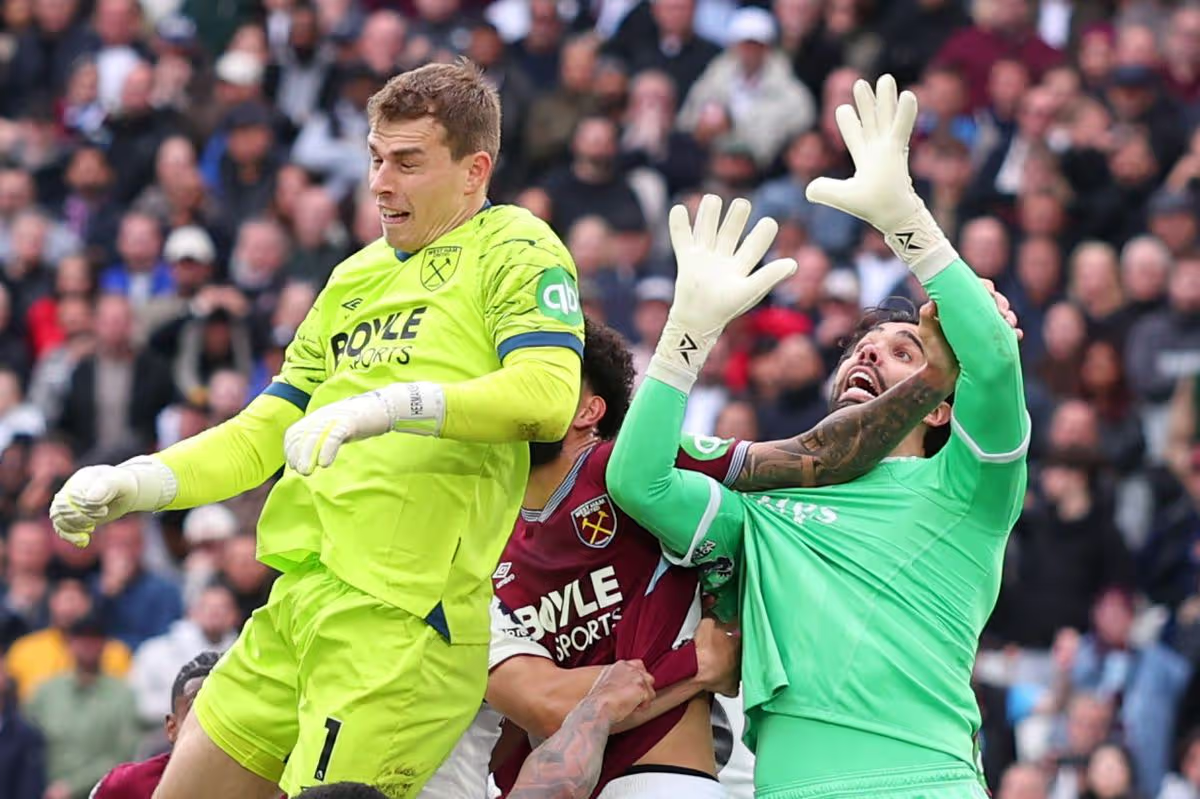
Eight minutes. That’s how long the London Stadium held its breath while Darren England stared at a monitor in Stockley Park and decided whether Callum Wilson’s stoppage-time equaliser — scored in front of a desperate, delirious crowd — counted or didn’t. In a game that could relegate West Ham and hand Arsenal the Premier League title. In the 94th minute. With everything on the line.
Eight minutes. For a decision that, when it came, split the entire football world straight down the middle.
Gary Neville called it “the biggest VAR decision in Premier League history.” Howard Webb called it a “clear and obvious offence.” Jarrod Bowen said football got hurt. Tomas Soucek said he couldn’t believe what he was seeing. Mikel Arteta thanked the referee for being brave. Nuno Espirito Santo said the referees don’t even know what to call anymore.
They’re all right. And they’re all wrong. And that’s the problem.
What Actually Happened
Let’s start with the facts, because the facts are less disputed than the reaction suggests.
Bowen swung in a corner. Raya came to claim it. In the melee in the six-yard box, West Ham forward Pablo — tracking the flight of the ball — made contact with Raya’s arm, restricting the goalkeeper’s ability to punch or catch cleanly. The ball dropped. Wilson reacted quickest and finished. The on-field referee Chris Kavanagh initially awarded the goal. VAR reviewed it. Eight minutes later, Kavanagh went to the monitor, confirmed Pablo’s contact constituted a foul, and disallowed the goal. Arsenal held on to win 1-0. Webb confirmed the following day it was correct: “Raya can’t do what he would normally do in that situation, simply catch the ball or punch the ball, and they intervene.”
Was it a foul? Almost certainly yes. Was it the kind of foul that stops play in a Premier League match without VAR involvement? Almost certainly no. And that gap — between technical correctness and practical footballing reality — is where all the pain lives.
The Case For: VAR Got It Right
tart with the principle. Goalkeepers are uniquely vulnerable figures in football. They cannot protect themselves the way outfield players can. They’re committed to a movement going for the ball at the moment contact is made, and they cannot abort that movement or brace for impact the way a defender can when they’re shoulder-barged. The law exists precisely to protect them from being rendered physically unable to do their job.
Pablo’s contact with Raya’s arm was real. It was deliberate in the sense that he was pushing toward the ball and Raya was in the way. It prevented Raya from making the play he would otherwise have made. The goal that followed was a direct consequence of that contact. Under the laws of the game as they stand, that is a foul. VAR found it. VAR did its job.
Webb’s point on this is worth taking seriously. “We’ll continue consulting, but certainly we need to be vigilant.” He’s not saying the call was marginal. He’s saying it was clear and that the kind of physical intervention on goalkeepers that has been ignored for years now needs to be consistently penalised. If you believe in the principle of protecting goalkeepers, you have to accept this decision.
The inconvenience of the timing — stoppage time, relegation battle, title race is not VAR’s problem. A foul is a foul in the 94th minute as much as it is in the 14th. The technology exists to find it. The technology found it. That is what the technology is for.
The Case Against: This Is Killing the Game
Now the other side. And it’s just as valid.
Contact in penalty areas at corners is constant, universal and essentially unpoliceable in real time. Every corner kick in every Premier League game involves pushing, holding, shirt-grabbing and physical jostling that technically violates the laws of the game. Defenders hold attackers. Attackers block defenders. Goalkeepers get bumped. All of it, every week, in every match, and maybe 2% of it gets called — usually when it’s egregious and the referee is right on top of it.
Bowen’s point about consistency is the sharpest argument against the decision: “If you’re going to give decisions like that you have to give all the holding calls in the world.” He’s right. Arsenal score regularly from set pieces — Saliba, Gabriel, Rice — and the physical play that goes on in those moments is not materially different from what Pablo did to Raya. If this is the standard, the standard must apply everywhere. Every game. Every corner. Every push and grab and arm across a body. You can’t selectively enforce it in the 94th minute of a title-deciding game and then look the other way for 37 other gameweeks.
Soucek put it most honestly: “I am a fan of VAR because football should be fair. But football got hurt today.” He’s not wrong that VAR should exist for genuine injustices. An obvious offside. A clear handball. A red card for violent conduct that the referee missed. What he’s questioning — rightly — is whether the subjective, barely-visible contact in a crowded penalty area is genuinely the kind of injustice VAR was invented to correct. Or whether, in correcting it, VAR creates a different and arguably larger injustice: the removal of spontaneous human football moments from the game.
Eight minutes. A legitimate goal, celebrated by a crowd of 62,000 people, taken away after eight minutes of staring at freeze frames. Whether the decision is technically correct or not — and it probably is — the experience of watching that unfold is actively damaging the emotional relationship between football and its audience.
The Three Fixes That Could Actually Work
The debate about whether VAR should exist has been settled. It exists. It’s not going anywhere. The question is how to make it work better. Here are three proposals that deserve serious consideration — and that the Premier League has been discussing in various forms for two seasons.
Fix 1: Trained Full-Time VAR Officials
The current system asks match referees to rotate into the VAR role — meaning the person watching the monitors in Stockley Park is the same individual who was running the line at Burnley last Tuesday. VAR is a fundamentally different skill set to on-field refereeing. It requires systematic review methodology, a specific understanding of camera angles and freeze-frame interpretation, and the ability to make high-pressure decisions under a different kind of scrutiny to the pitch.
Other major sports have addressed this. The NFL’s replay officials are dedicated specialists who do nothing else. Tennis’s Hawk-Eye system is operated by trained technicians, not former players. The Premier League should create a dedicated pool of full-time VAR officials who are trained specifically for the role — not retired referees doing a rotation, but specialists in video review and law interpretation. The marginal calls will always be marginal. But the process of reaching a decision can be made more consistent and more defensible with dedicated expertise.
Fix 2: The 60-Second Clock
Eight minutes destroyed the West Ham match as a sporting event. From the moment the ball hit the net to the moment the decision came, the game was in suspended animation. The crowd couldn’t celebrate. The players couldn’t process. The managers stood on the touchline not knowing what to tell their players. Sixty-two thousand people held hostage to a process that, ultimately, produced a decision most neutrals wouldn’t have spotted in real time anyway.
Introduce a 60-second clock for VAR reviews. One minute. If the VAR official cannot confirm a clear and obvious error in 60 seconds — defined as an error so clear that a reasonable person watching the review footage would agree it’s definitive — the on-field decision stands. Not 90 seconds. Not two minutes. Sixty seconds. The longer a review takes, the more likely it is that the decision is genuinely marginal — and genuinely marginal decisions should not be overturning spontaneous football moments.
The counter-argument — what about genuine errors that take time to find? — is answered by the “clear and obvious error” threshold that VAR is already supposed to apply. If it takes eight minutes to find it, it’s not clear and it’s not obvious. The clock would enforce the principle that was already supposed to govern VAR’s operation but has been allowed to drift into something much more forensic and much more destructive.
Fix 3: Defined and Published Categories
The third problem is the one Nuno and Bowen identified most directly: nobody knows what the rules are. Not the managers. Not the players. Not the fans. Not apparently the referees themselves. “Even the referees don’t know what to call,” Nuno said. That is a devastating indictment of the current system from a man who works within it every week.
The Premier League should publish a defined list of reviewable incidents at the start of every season — specific categories with specific thresholds — and stick to them. Goalkeeper contact should be on that list with a defined description of what constitutes a foul: not “any contact” but “contact that materially prevents the goalkeeper from making a play they would otherwise have made.” That definition, published, agreed upon and applied consistently, would give everyone — players, managers, fans — a framework to understand what VAR is and isn’t looking for.
Without it, every borderline decision becomes a referendum on the entire system. With it, the argument moves from “was that even a foul?” to “did that meet the published threshold?” That’s a better argument. A more solvable argument.
The Stardraft Angle: Because Fantasy Football Doesn’t Stop for Philosophy
The VAR decision had a very specific fantasy football consequence that’s worth acknowledging. West Ham’s goal would have been worth nothing in Stardraft — it was disallowed. But Callum Wilson’s involvement in the play, Bowen’s delivery, Raya’s saves before the incident — all of those contributed to Stardraft points that were earned regardless of the controversy. The Stardraft system rewards the full game, not just the goals and assists that survive an eight-minute video review.
Which is, perhaps, the most fitting observation you can make about the state of VAR in 2026. Football has become a game where a goal can exist and not exist simultaneously for eight minutes. Where a crowd can celebrate and then have that celebration taken away. Where the emotional truth of the moment — West Ham equalised — and the technical truth of the moment — the goal was disallowed — coexist in tension with each other.
Sixty-second clock. Trained officials. Published categories. Not complicated. Not revolutionary. Just the minimum standard required to make VAR something that football can live with rather than something football has to survive.
The Final Statr Verdict
The decision was probably correct. The process was unacceptable. Both things are true. The goal should probably have been disallowed. But not like that. Not after eight minutes. Not in a game with that much riding on it, for both clubs.
VAR isn’t going anywhere. The question is whether the people running football have the will to reform it into something that serves the game rather than just making correct decisions in the most damaging way possible. The Pablo foul on Raya was real. The eight-minute review was a choice. And that choice — to drag football’s most contested weekend through the longest, most agonising review in memory — is the choice that the Premier League needs to answer for.
Football got hurt on Sunday. Not because the decision was wrong. Because of how it was made.
Follow the debate on the Stardraft blog and the Stardraft podcast on Spotify. Download the app — iOS | Android. Drop your verdict in the comments — was the VAR decision right? And how would you fix it?


Comments are closed